

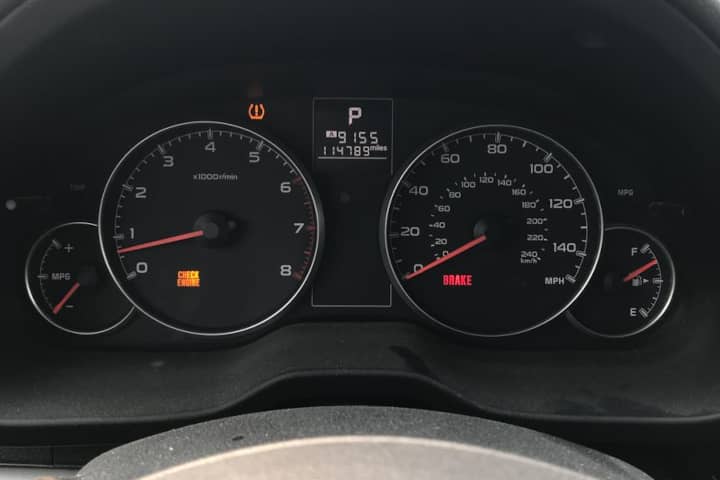
A 2013 Subaru Outback came to Hoover Street Auto Repair with the Check Engine Light, cruise control light, and brake warning light flashing. The owner reported the vehicle drove without issue.
Page Contents
- Diagnostic Testing
- Technician's Recommendation
- Repair Performed
- Transmission Repair FAQ
- Subaru Transmission Tips
- Recommend Subaru Repair Shop
Diagnostic Testing
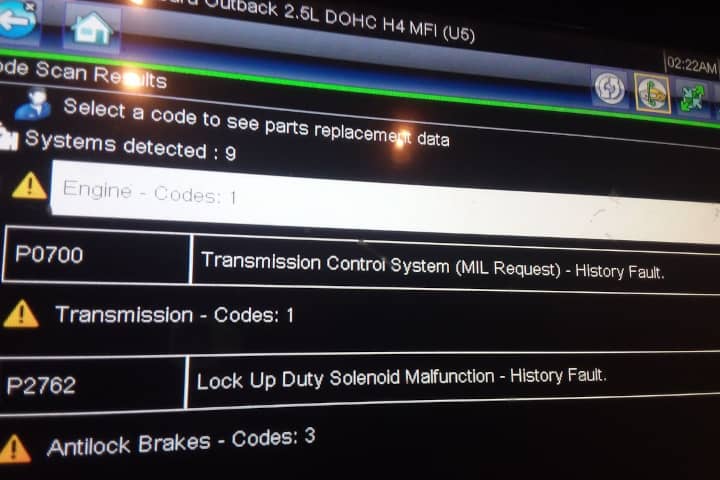
Our Subaru technician performed a check engine light diagnostic and found an error code indicating a malfunction of the automatic transmission torque converter lock-up duty-cycle solenoid. Next, they disconnected the electrical cable to the valve body and tested all six solenoids, finding the torque converter lock-up solenoid was defective.
Technician's Recommendation
The technician recommended a transmission valve body replacement, clearing previous error codes with the scan tool, and retesting for additional problems. Even though this vehicle had only 115k miles on the odometer, it was showing signs of transmission problems.
Repair Performed
Our technician removed the necessary components to gain access to and remove the valve body assembly from the transmission. Next, the transmission was inspected and deemed serviceable. The customer was asked for approval to proceed with the valve body replacement.
Next, the technician removed the old gasket, and the housing surfaces were cleaned and prepared for the new gasket. The new valve body assembly was installed with associated gaskets and seals. Then the components removed during the repair were reassembled. Next, the computer error codes were cleared, the vehicle was road-tested, the transmission operation was checked, and it was verified that the check engine, cruise control, and brake warning lights were no longer present. The transmission now functioned as designed.
Subaru Transmission FAQ
How much does a 2013 Subaru Outback transmission valve body replacement cost?
The national average cost for a 2013 Subaru Outback Transmission Valve Body Replacement ranges from $1,300* to $1,500*, with 78% parts and 22% labor. Diagnosis, additional parts, environmental disposal fees, and taxes are not included. Prices differ depending on your location.
Note: the individual transmission solenoids are not available from Subaru. The complete valve body assembly must be replaced. There are no aftermarket parts available.
How do I know if my Subaru transmission valve body is bad?
A Check Warning Light is the most common symptom of a Subaru CTV transmission valve body failure. The second most common symptom is transmission shifting problems. There are reports of the transmission valve body problem causing engine stalling, vehicle bucking, or sudden transmission lock-up.
Can you drive with a bad valve body?
You should not continue driving a Subaru with a faulty valve body. A failing valve body can cause damage to other parts of the transmission, leading to costly transmission repairs or total transmission replacement. The transmission can lock up or fail without warning.
Subaru Transmission Tips
- Don't ignore warning lights on a Subaru! Waiting until the transmission starts to exhibit symptoms or problems may result in transmission damage requiring very expensive total transmission replacement.
- Find a repair shop that is familiar with Subaru CTV transmissions. These transmissions are VERY expensive and are considered non-repairable except for the valve body. This is not a transmission to touch if the repair shop does not know what they are doing! If the transmission fails, a completely new replacement transmission will be needed.
- Experience has shown that CVT transmissions will have fewer problems and last longer if they have regular transmission fluid replacement. Subaru factory claims that the CVT transmission has “lifetime” fluid and it does not need to be changed. A transmission service is very low-cost compared to a transmission replacement, which averages $7,000* to $10,000*.
- We recommend replacing the transmission fluid every 30,000 miles to prevent problems. Please note that there is rarely any benefit to changing the fluid after a transmission has a problem.
- Make sure the transmission is otherwise in good mechanical condition before replacing the valve body.