
Hoover Street Auto Repair performs automotive tune-ups in Ann Arbor, Michigan. We specialize in Asian and Japanese auto tune-up as well as domestic cars, SUVs, vans, light trucks, and RVs. Our auto service technicians are ASE-certified, and we have the tools to test and repair any tune-up problem.
Having problems with a rough-running engine, engine misfire, and poor gas mileage? Regular engine tune-ups can restore smooth running, performance, and fuel efficiency to your vehicle.
If your dashboard warning light is on, our check engine light diagnostics in Ann Arbor can pinpoint whether a tune-up will solve the problem.
Hoover Street Auto Repair has been performing automotive tune-up service in Ann Arbor since 1980. They pride themselves on offering exceptional service for Asian, Japanese, and domestic cars, SUVs, vans, light trucks, and RVs.
Contact Hoover Street Auto Repair today for a tune-up estimate or to make an appointment.
Our Tune Up Service
We have a standard engine diagnostic (test) fee and then charge for any required service & repair, such as spark plug, fuel filter, or air filter replacement. We do not use false "tuneup" prices.
Tune Up Procedure
First, we ask you a few questions:
- Does your car not run correctly?
- Do you have a check engine light on?
- How many miles are on your vehicle?
- When was the last time the engine was serviced?
Once we have the vehicle:
- We start with a vehicle computer diagnostic test.
- Then perform a visual inspection of tune-up-related parts and systems.
- We will contact you with test/inspection results and advise on the required service.
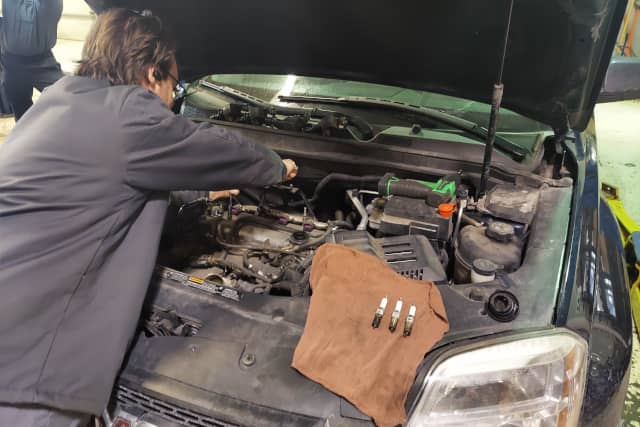
What Tuneup Includes
The following systems are inspected as part of your tune-up service:
- computer diagnostic check;
- battery, charging, and starting systems check;
- engine mechanical condition check;
- fuel system check;
- ignition system check;
- emissions systems (PCV, EGR, Evap) check*;
- distributor cap inspection (if applicable);
- Ignition rotor inspection (if applicable).
The following parts are replaced as part of your tune-up service:
- spark plug replacement;
The following parts are replaced if required:
- fuel filter replacement*;
- air filter replacement*;
*Additional cost for some vehicles.
For good value and convenience, we suggest getting an oil change service at the same time as a tune-up inspection. A digital report is included with an oil and filter service on most vehicles.
Tuneup Price:
- The diagnostic & inspection fee and parts cost vary by vehicle type.
- From the test and inspection, we can provide a tune-up service estimate.
- You decide what recommended services are done.
When is a tune-up required?
Often, vehicle owners wait until the Check Engine Light comes on or the vehicle starts running poorly before they ask for a "tune-up." In both cases, waiting until there is a problem can cost you more than a regular tune-up service.
We recommend you follow your vehicle maintenance schedule. Vehicle manufacturers have different maintenance recommendations based on vehicle use and distance driven. Usually, the spark plug replacement interval can serve as a rough guide for tune-up service requirements if you need help.
Many people think of a tune-up when their vehicle starts running rough or when the check engine light is on. If your vehicle is not running correctly or the check engine light is on, a diagnostic inspection is the best place to start.
Any problems between regular maintenance intervals usually indicate a problem that should be investigated and repaired. Maintenance periods of modern vehicles vary greatly. To ensure good performance, fuel economy, and reduced emissions, it is best practice to follow the vehicle's maintenance schedule in your owner's manual.
Vehicle manufacturers specify regular maintenance to be performed at certain time intervals or mileage thresholds. Most manufacturers no longer use the term "tune up," but the general public commonly uses it. The closest maintenance item to the commonly used "tune-up" service is spark plug replacement.
Your vehicle owner's manual will recommend the spark plug replacement interval. If the majority of your driving is stop-and-go city driving, you should follow the "Severe Service" maintenance schedule.
The three most common parts related to a tune-up are sparkplugs, the fuel filter, and the engine air filter.
Modern vehicles use high-tech spark plugs and ignition components, which have longer lifespans and extended service intervals. But as your vehicle ages, other wear and serious mileage-related problems can shorten your spark plugs' lifespan.
Common Tune-Up Related Problems:
- Rough-running engine repair: this is usually most noticeable at idle, such as when waiting at a traffic light.
- Trouble starting the car: hard starting is most noticeable during cold winter temperatures. Everything needs to be in top condition to avoid cold-weather starting problems.
- Engine misfire repair usually happens during acceleration or pulling up a steep hill. A misfiring engine problem is quite noticeable and usually triggers a Check Engine Light warning. A misfire can also damage the catalytic converter, which is very expensive to repair.
- Engine stalling: A rough-running engine is more prone to stalling. A weak or failing fuel pump or emission system problems can also cause engine stalling.
- Poor fuel mileage: if the spark plugs are worn out or the air filter is plugged, fuel mileage will decrease.
- Excessive engine oil burning repair: Causes spark plug fouling, oxygen sensor failure, and catalytic converter damage—a common problem with high-mileage vehicles.
- Seized spark plug replacement: if spark plugs are not removed periodically, they can seize or become stuck in the cylinder head. Often, this requires replacing the cylinder head, which can cost many thousands of dollars. Although the spark plug replacement interval may be 60,000 to 100,000 miles, there may be a risk of a seized spark plug if they are not changed sooner. Your vehicle manufacturer may have updated (shortened) the spark plug change interval since your vehicle was built. We always check for updated spark plug service bulletins when your vehicle is in the shop.
- Ignition part replacement: worn spark plugs overload and damage other ignition components. Bad spark plugs can cause ignition coil failure.
- Catalytic converter replacement: caused by spark plug misfire and excessive engine oil burning.
Tune-up History
Historically, the term 'tune-up' was associated with the frequent replacement of ignition components such as spark plugs and breaker points. Demands for lower vehicle emissions and greater fuel economy pushed vehicle manufacturers to adopt electronic ignition systems and to replace carburetors with electronic fuel injection. This eliminated the need for frequent tune-up part replacements and adjustments of many ignition and fuel system components.
High Tech Tune-ups
As vehicle technology progressed, the procedures required to perform a tune-up changed dramatically. Highly sophisticated ignition and fuel systems, which use one or more computers to control critical engine and transmission management functions, require specialized tools and auto repair technician skills. Fuel consumption and exhaust emissions decreased, and tune-up intervals became much longer.
Is A Tune-up Still Required?
Contrary to common belief, modern hi-tech vehicles still need tune-ups to maintain peak performance and fuel efficiency.
Although tune-up parts and procedures have changed greatly, there is still a need to maintain the ignition and fuel systems. Modern vehicles are very reliable and will run unmaintained for a long time, but parts eventually wear out and fail if not properly maintained at regular intervals.
Tuneup Parts Replacement
Spark Plugs
Spark plug life has been greatly extended with the accurate fuel control provided by computer-managed fuel injection. Part replacement schedules vary greatly, so the manufacturer's maintenance recommendation should be followed.
Air & Fuel Filters
Air and fuel filters have a major impact on engine performance and should be replaced regularly. Filter life depends greatly on the conditions under which the vehicle is operated.
Spark Plug Wires, Distributor Cap, and Rotor
With the demands of high-energy electronic ignition systems and exposure to extremely high engine compartment temperatures, these ignition parts deteriorate, placing additional load on expensive ignition coils and control system components. It is highly recommended to replace spark plug wires and, where used, the distributor cap and rotor. Your vehicle maintenance schedule will recommend when to service these parts.
Electrical System Analysis
The electrical system is the heart of a modern vehicle and should be tested at each tune-up. A weak battery or charging system problem can cause major problems, such as engine stalling or poor performance, erratic check engine warning lights, or cause serious damage to highly sensitive electronics throughout the vehicle, resulting in costly repairs.
A weak or bad battery can result from a battery defect, overcharging, or undercharging due to a bad drive belt, a faulty voltage regulator, or an electrical drain from an electrical short. A starter problem can also damage the battery by placing a higher electrical load on the battery.
Contact Hoover Street Auto Repair if you have any questions about tune-ups or spark plug replacements.