
Hoover Street Auto Repair provides expert suspension repair in Ann Arbor, MI, for cars, trucks, and SUVs. We service Asian import autos, including Acura, Honda, Hyundai, Infinity, Kia, Lexus, Mazda, Nissan, Subaru, Toyota, and domestic autos, including Buick, Cadillac, Chevrolet, Chrysler, Dodge, Ford, GMC, Jeep, Lincoln, and Ram. Serving Ann Arbor, Ypsilanti, Saline, Dexter, and Pittsfield. ASE- and Michigan state-certified technicians. Same-day service available. Call (734) 913-6272 to schedule.
Ann Arbor roads are hard on suspension components. Between winter potholes, frost heaves, and the constant wear of city driving near the University of Michigan campus, shocks, struts, ball joints, and control arm bushings take a beating year-round. When suspension parts wear out, your vehicle handles less predictably, your tires wear faster, and safety suffers.
At Hoover Street Auto Repair, our ASE- and Michigan State-certified auto repair technicians have been diagnosing and repairing suspension systems since 1980. As a NAPA Auto Care Center, we service Asian import vehicles as well as domestic brands. Whether you are driving a compact Front Wheel Drive sedan or a full-size 4x4 pickup, we have the expertise to restore your vehicle's ride quality and handling.
We also offer an Annual Vehicle Physical -- a comprehensive vehicle inspection that includes a thorough suspension check -- to catch wear before it becomes a safety issue.
What Does the Suspension System Do?
The suspension system connects your wheels to your vehicle's frame or body. Its primary job is to absorb road impacts -- potholes, bumps, and uneven pavement -- so that energy is not transferred directly into the passenger compartment. Just as importantly, it keeps your tires in firm contact with the road surface at all times, which is what allows your brakes and steering to work effectively.
The suspension and steering systems work together. When suspension components wear out, steering response becomes vague, the vehicle may pull to one side, and handling in corners and lane changes deteriorates. A healthy suspension system is not just about ride comfort -- it is a direct safety system that affects your ability to control the vehicle in every driving situation.
Common Suspension Problems
Suspension wear is gradual, which is why many drivers do not notice it until a component fails or a technician identifies it during an inspection. Here are the most common suspension problems we diagnose and repair:
- Worn shock absorbers or struts. Shocks and struts control spring motion after a bump. When they wear out, the vehicle bounces excessively, handling becomes unpredictable, and stopping distances increase.
- Broken or worn springs. Suspension springs support the vehicle's weight and work alongside shocks or struts. A broken or sagging spring causes uneven ride height and can allow the suspension to bottom out on larger road impacts.
- Worn control arm bushings. Rubber bushings cushion the control arm's connection to the vehicle frame. When they deteriorate, the result is clunking noises, vibration, and reduced steering precision.
- Worn ball joints. Ball joints are pivot points that allow the wheels to steer and move with the suspension. Worn ball joints cause loose, vague steering and can produce a knocking sound over bumps. Severely worn ball joints are a safety hazard.
- Worn sway bar links. The sway bar (stabilizer bar) limits body roll in turns. Worn links or bushings cause a clunking or rattling noise, particularly over bumps or during low-speed maneuvering.
- Damaged strut mounts. The strut mount connects the strut assembly to the vehicle body and includes a bearing that allows the strut to rotate during steering. A worn or damaged strut mount causes noise, vibration, and stiff steering.
- Cupped or scalloped tires from worn shocks. When shock absorbers lose their damping capacity, tires begin to bounce on the road rather than roll smoothly. This creates a distinctive cupped or scalloped wear pattern across the tread and causes vibration at highway speeds.
Common Tire Wear Causes
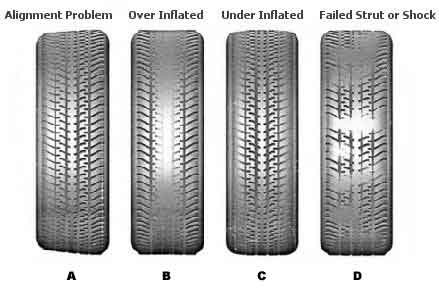
Worn suspension parts can cause abnormal tire wear. Tire wear patterns are a very good diagnostic tool in pinpointing which suspension parts are worn and need to be replaced.
- Tire wear resulting from a wheel alignment problem. Usually caused by suspension and steering part wear or damage caused by impact or collision. The inside or outside of the tire is worn off at a very noticeable angle.
- Tire wear caused by over-inflation (tire pressure too high). The middle section of the tire tread is forced outward by excess pressure and wears faster than the outer edges.
- Tire wear caused by under-inflation (low tire pressure). The most common problem we see during our Annual Vehicle Inspection service! The tire cannot support the vehicle's weight, forcing the middle section inward and causing excessive wear on both outer edges of the tread.
- Tire wear caused by worn-out shock absorbers or struts, and or incorrect tire balancing. Worn patches on the tire were caused by the tire bouncing on the road, creating high stress and excessive wear, likely due to either incorrect tire balance or worn shock absorbers. Often, out-of-balance tires cause shock or strut wear to occur prematurely, amplifying tire bounce and excessive wear.
Our Suspension Services
We offer a full range of suspension repair and maintenance services for both Asian import and domestic vehicles:
- Shock absorber replacement. We replace worn shocks in pairs (both fronts or both rears) to restore balanced, controlled damping across the axle.
- Strut replacement. Strut assemblies are replaced as a complete unit or with new individual components as appropriate, followed by a wheel alignment check.
- Control arm and bushing replacement. We inspect and replace control arms and worn rubber or polyurethane bushings to eliminate noise and restore precise steering geometry.
- Ball joint replacement. Upper and lower ball joints are inspected for play and replaced when wear thresholds are exceeded, restoring safe, responsive steering.
- Sway bar link and bushing replacement. We replace worn sway bar links and end bushings to eliminate rattles and restore cornering stability.
- Suspension inspection. A complete inspection of all suspension components, including a check of wheel alignment angles, to identify current wear and flag developing issues.
- Tire rotation and balancing. We recommend rotating tires every 15,000 miles and using a computerized wheel balancer to eliminate vibration and minimize uneven tread wear caused by excess suspension movement.
Shocks and Struts
Shocks (shock absorbers) and struts both control how your vehicle's springs move after hitting a bump, but they are structurally different. A shock absorber is a standalone damping unit mounted alongside a separate spring. A strut combines the shock absorber, the structural strut tube, and the wheel spindle into a single assembly, with the coil spring mounted around it. Many front-wheel-drive and compact vehicles use McPherson struts up front; rear-wheel-drive vehicles and larger trucks more commonly use separate shocks and coil springs.
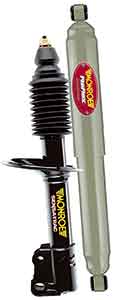
Both types wear out gradually. A common replacement guideline is around 50,000 miles, though driving habits and road conditions in Ann Arbor can accelerate that timeline. Signs of wear include a bouncy or rough ride, nose-dive under braking, body sway in corners, and vague or slow steering response. Visually, look for fluid leaks along the shock body or dented and physically damaged housings. Because shocks and struts wear at similar rates across an axle, replacing them in pairs ensures balanced handling. Worn shocks also cause tire cupping -- an irregular wear pattern that shortens tire life and creates highway vibration.
Suspension Types We Service
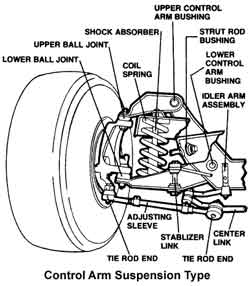
The two most common passenger-vehicle suspension configurations are the McPherson strut system and the control-arm (double-wishbone or SLA) system.
McPherson struts are standard on most front-wheel-drive vehicles and compact cars. The strut acts as both the structural suspension member and the damping unit, with the coil spring mounted around it. This is the most common front suspension design on the vehicles we service every day.

Control arm systems use upper and lower control arms with a coil spring and a separate shock absorber mounted between them. Ball joints at the outer ends of the control arms allow for wheel movement and steering. This configuration is common on rear-wheel-drive vehicles and many trucks. Our service team fully supports both systems.
Frequently Asked Questions
1. How do I know if my shocks or struts are worn out?
Several signs point to worn shocks or struts. Performance symptoms include a bouncy or harsh ride, excessive body roll when changing lanes or cornering, nose-dive when braking hard, and a vague or slow steering response. You may also notice the vehicle wandering on the highway. Visually, look for oil leaking from the shock body, physical damage to the housing, and cupped or scalloped tire wear—an uneven, wavy wear pattern around the tread circumference. If you notice any of these signs, bring the vehicle in for an inspection. Worn shocks do not always feel dramatically different at first; the change happens gradually, which is why a periodic inspection is worthwhile.
2. How much does suspension repair cost in Ann Arbor?
Suspension repair costs vary depending on the specific component, the vehicle make and model, and whether other related work (such as a wheel alignment) is needed at the same time. Shock absorber replacement on a standard sedan is generally less expensive than strut replacement, which involves more labor and typically requires a wheel alignment afterward. Ball joint and control arm work varies significantly by vehicle. We provide a written estimate before any work begins. Because Hoover Street Auto Repair has served Ann Arbor since 1980, we understand the value of straightforward pricing -- no surprises when picking up your vehicle.
3. Should shocks and struts be replaced in pairs?
Yes. Shocks and struts on the same axle wear at similar rates because they experience the same road conditions and loads. Replacing only the worn side creates an imbalance in damping performance between the left and right sides, which can cause the vehicle to pull or handle unevenly. Replacing both units on the axle at the same time restores balanced handling and is generally more cost-effective than coming back to replace the second one a short time later.
4. What causes a bouncy ride?
The most common cause of a bouncy or floating ride is worn shock absorbers or struts. Their job is to limit how far and how fast your springs compress and rebound after a bump. When that damping ability is reduced, the spring energy is not absorbed quickly enough, and the vehicle continues to bounce. Other contributing factors include worn strut mounts, incorrect tire pressure, and broken or sagging springs. In some cases, tire imbalance can also create a rhythmic bounce or vibration at specific speeds. A suspension inspection will identify the root cause.
5. How do Ann Arbor roads affect my suspension?
Ann Arbor's climate creates challenging conditions for suspension components. Freeze-thaw cycles crack and heave pavement throughout the winter and early spring, producing the deep potholes that are familiar to anyone driving near the University of Michigan campus or on older residential streets. Each pothole impact sends a shock load through your shocks, struts, springs, ball joints, and bushings. Vehicles driven primarily in Ann Arbor and surrounding communities, such as Ypsilanti and Pittsfield, typically experience accelerated suspension wear compared to vehicles driven on newer, smoother roads. This is why we recommend at least an annual suspension inspection—and why our Annual Vehicle Physical is a practical choice for local drivers.
6. Do you service both Asian import and domestic vehicles?
Yes. Hoover Street Auto Repair has specialized in Asian import vehicles since the 1980s and regularly services Honda, Acura, Toyota, Lexus, Mazda, Nissan, Infiniti, Subaru, Kia, and Hyundai. We also service domestic brands including Chevrolet, Ford, GMC, Dodge, Ram, and Chrysler. Our ASE-certified technicians are experienced with the suspension designs common across these platforms, from McPherson strut systems on compact imports to control-arm and coil-spring setups on domestic trucks and SUVs.
Vehicles We Service
Hoover Street Auto Repair services a wide range of Asian import and domestic vehicles. Our suspension repair experience covers Honda, Acura, Toyota, Lexus, Mazda, Subaru, Nissan, Infiniti, Kia, and Hyundai—the brands most commonly seen in our bays. We also fully service domestic vehicles, including Chevrolet, Ford, GMC, Dodge, Ram, and Chrysler cars, trucks, and SUVs. If you are unsure whether we work on your vehicle, give us a call—chances are, we do.
Serving Ann Arbor and Surrounding Areas
Hoover Street Auto Repair is located in Ann Arbor near the University of Michigan Stadium and campus and has been a trusted resource for local drivers since 1980. We serve customers throughout Ann Arbor and the surrounding communities of Ypsilanti, Saline, Dexter, and Pittsfield. If you live or work in the area and your vehicle is experiencing suspension issues, we offer same-day service for most suspension repairs.
Schedule Your Suspension Inspection Today
If your vehicle is pulling, bouncing, or handling poorly, do not put off a suspension check. Worn suspension components affect your safety and accelerate tire wear -- problems that get more expensive the longer they go unaddressed. Call Hoover Street Auto Repair at (734) 913-6272 to speak with a technician or schedule an appointment. You can also book online at your convenience. We offer same-day service for most suspension repairs and provide a written or digital estimate with photo and video evidence before any work begins.